
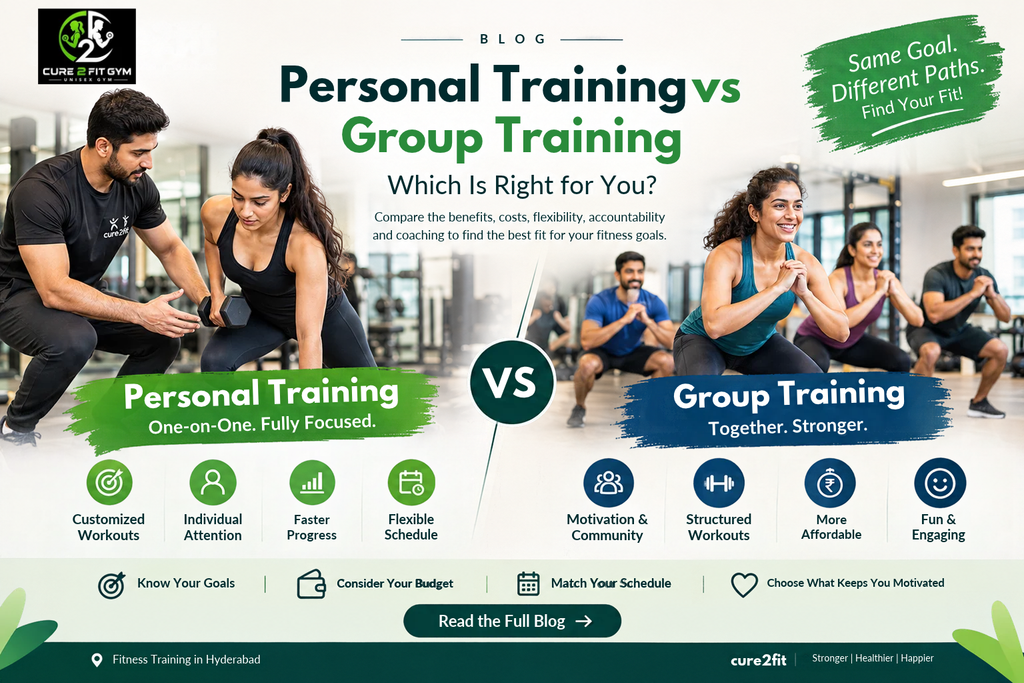
Choosing how to train can be just as important as choosing where to train.
If you are planning to start your fitness journey, you may be wondering: Should I choose personal training or join a group training class?
Both options can help you become more active, improve fitness, build strength, and develop a consistent workout routine. However, the right choice depends on your goals, experience, schedule, budget, and the type of environment that helps you stay motivated.
In this guide, we’ll compare personal training vs group training, explain the advantages of each, and help you understand which training format may fit your lifestyle.
Personal training is a one-to-one training approach where a fitness professional designs and supervises workouts based on an individual’s goals, abilities, and training experience.
A personal trainer can help you with:
Because the trainer is working directly with you, the session can be adjusted according to your current fitness level and goals.
A typical personal training program may begin with an assessment of your goals, fitness experience, movement ability, schedule, and lifestyle.
Your trainer can then create a structured program around your requirements.
For example, someone focusing on improving strength may need a different program from someone whose primary goal is improving cardiovascular fitness.
Group training involves exercising with several other people under the guidance of a trainer or fitness professional.
Depending on the gym or fitness centre, group sessions can include:
One of the biggest advantages of group training is the social environment. Exercising alongside other people can create a sense of community and make workouts more engaging.
The biggest difference is the level of individual attention.
| Factor | Personal Training | Group Training |
| Attention | One-to-one | Shared among participants |
| Workout | Highly individualized | Structured for the group |
| Accountability | Highly personalized | Group-based |
| Social environment | More private | More social |
| Scheduling | Often flexible | Usually fixed class times |
| Cost | Generally higher | Often more affordable |
| Technique feedback | More individual attention | Trainer divides attention |
| Community | Limited | Stronger group interaction |
Neither format automatically produces better results for everyone. The important question is whether the training environment matches your needs and helps you exercise consistently.
Personal training allows the workout to be adjusted to your goals and current abilities.
Your trainer can modify exercises, repetitions, resistance, rest periods, and progression according to your program.
This can be particularly useful if you are new to exercise or have specific fitness objectives.
During a one-to-one session, the trainer’s attention is focused primarily on you.
This can make it easier to receive feedback about:
Learning proper exercise technique is especially important when using resistance training equipment.
One of the challenges of fitness is consistency.
Having scheduled sessions with a trainer can create an additional layer of accountability. Instead of deciding every day whether you will exercise, your training sessions become part of your routine.
Research has also examined the role of supervised personal training in exercise adherence and found evidence that trainer-supervised programs can support participation compared with minimally supervised exercise.
Personal training can be structured around goals such as:
The program can evolve as your fitness level changes.
Training with other people can make exercise feel more social.
Seeing others working toward their own goals can encourage you to participate consistently.
Recent research examining individual, small-group, and large-group exercise found associations between group exercise, satisfaction, and exercise frequency, although the study was relatively small and should not be treated as proof that group training is universally better.
For some people, the social aspect of group fitness is a major reason they continue exercising.
You may get to know other members, develop friendships, and feel part of a fitness community.
That can make the gym experience more enjoyable.
Many people don’t want to spend time deciding what exercise to perform next.
A group class typically has a predefined workout structure.
You arrive, follow the trainer’s instructions, complete the session, and leave.
This can be convenient for people who prefer a guided workout.
Group training generally spreads coaching across multiple participants, which can make it less expensive per person than one-to-one personal training.
If budget is an important factor, group training may provide a